What happens after Enshittification?
My favourite example of enshittificaiton, the process whereby products are changed to increase revenue at the cost of user experience, is YouTube—directly followed by Google. That’s because I was around to see it happen, and I remember the “golden age”, when YouTube and Google were actually great products, which I enjoyed using. YouTube is also the reason I decided to write this post. It is, however, a bad example, and streaming services like Netflix, Disney and HBO are much better examples.
Remember when Netflix posted on Twitter that sharing your password was love? The post is still online at the time of writing—no, I won’t link to it on X. Shortly after endorsing love, Netflix decided it was actually theft and cracked down on it. Netflix now costs twice as much, and if you’d like to share your account with a relative, you have to pay extra. I won’t get into the right and wrong of this decision, but I will say it’s a clear example of degrading the user experience to increase profits.
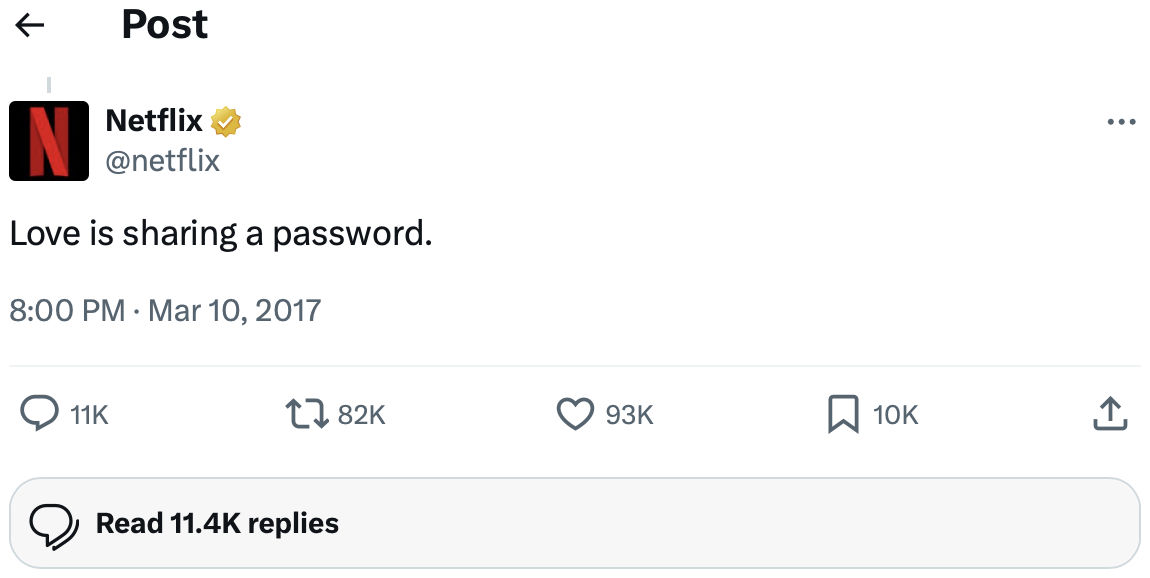
Post on X by Netflix: “Love is sharing a password.”
In recent years, we’ve seen other examples of enshittification of “big streaming”, such as HBO taking an award-winning exclusive off its streaming service because they didn’t like paying the artists their fair share. HBO isn’t alone in this, all streaming services are enacting cost-cutting measures that translate directly into taking shows offline. While my above example about Netflix was a less clear-cut one, this one is a lot easier to judge, I think.
Streaming services have killed cable, most shows are exclusives on one of the services and cannot be bought, and now they’re taking the shows offline, thereby removing all legal ways to pay for and watch a significant number of shows. This is enshittification.
To put a cherry on top, the user interface of Netflix, Disney, Amazon Prime Video, and all the rest of them are all terrible. All of them have very, very, bad search, are difficult to navigate, and some skip to the next episode of a show before the end-credits have even started. And this double-whammy of enshittification—the disappearance of old content and the headache-inducing UI—has lead to the rise of something unexpected and very predictable: Piracy platforms that stream everything in HD, for free, and have great UX. Or, alternatively: Millenials are collecting DVDs and BlueRays again.
Bringing this back to my initial question: What happens after enshittification? The streaming services’ experience suggests an answer: People will find or build alternatives. Here are more examples:
- Instagram, formerly known as a platform to share photos with friends and family, has become a video-first platform gaming its users dopamine to cause addiction and display as many ads as possible. The alternatives to Instagram are flourishing. To name two options: Pixelfed and Glass.
- The decentralised Mastodon is described by some of its users as a glass of ice water in the hell that is X, Threads, and BlueSky. Instead of cramming all users into one giant pool, it links many pools (servers) of users and when you sign up, you pick one of them as your home.
These examples suggest people will find and build alternatives to enshittified platforms, but there is another option nobody seems to be talking about: The Offliners.
People are going offline
As a result of the progressing enshittification of platforms with a monopoly on their corner of the market, some people appear to have had enough. Those people don’t measure easily, as they are absent from the system, out of range of tracking-cookies and analytics. And it’s not like large numbers of them coordinate to sign off and pursue lives away from screens at once, which would leave noticeable drops in usage-statistics. There is data, however:
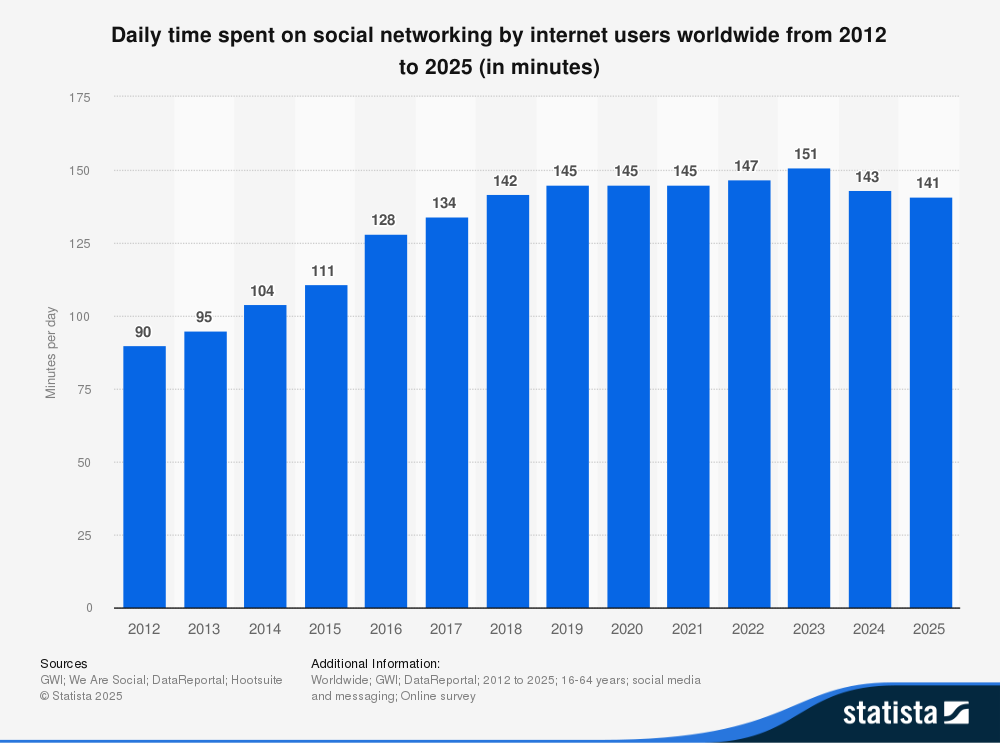
The time spent on social networking was stagnant from 2019 to 2022, peaked in 2023, in 2024 it dropped below 2022 levels and continued to fall in 2025.1 Consider this: An increasing number of people have access to the internet and the time spent on social media networking sites is dropping.
From what I can tell, many of them sign off gradually, slowly decreasing their usage of digital platforms. Their gradually decreasing use is invisible and easily offset by click-farms, fake accounts, AI-agents, and other growth factors that don’t represent actual human users.
This is what happens after enshittification
In conclusion then, it looks like the next chapter of the internet will be post-enshittification, and I expect we’ll see three things happen:
- Piracy will have a resurgence far greater than it already does. Not because people are unwilling to pay for movies and TV-shows, but because modern piracy-sites have better UX than paid sites.
- Social media will supplement the lack of human interaction with increasingly convincing AI-generated content. AIs will “watch” videos, reply to posts, and argue with each other. Some people will move on to platforms without algorithms or AI-agents.
- What was chord-cutting in the 2000s appears to be going offline in the 2020s.
I know, just recently, I posted about wanting to be more positive on this blog, so why am I posting this? I love what’s happening! I think it’s a good thing people are spending less time interacting with screens because I hope that means they spend more time interacting with each other. I think the downfall of platforms such as YouTube is necessary for new, and more democratic ones to have a chance. And I think the move away from Mark Zuckerberg’s imperium towards decentralised platforms is worthy of celebration. The internet isn’t dying, the monopolies are, and I’m here for it!
Update, February 23, 2026: A resurgence in blogging on personal websites, as well as an increasing number of private email-newsletters seems to be happening. Maybe people aren’t actually going offline, but simply moving “back” to web 1.0.